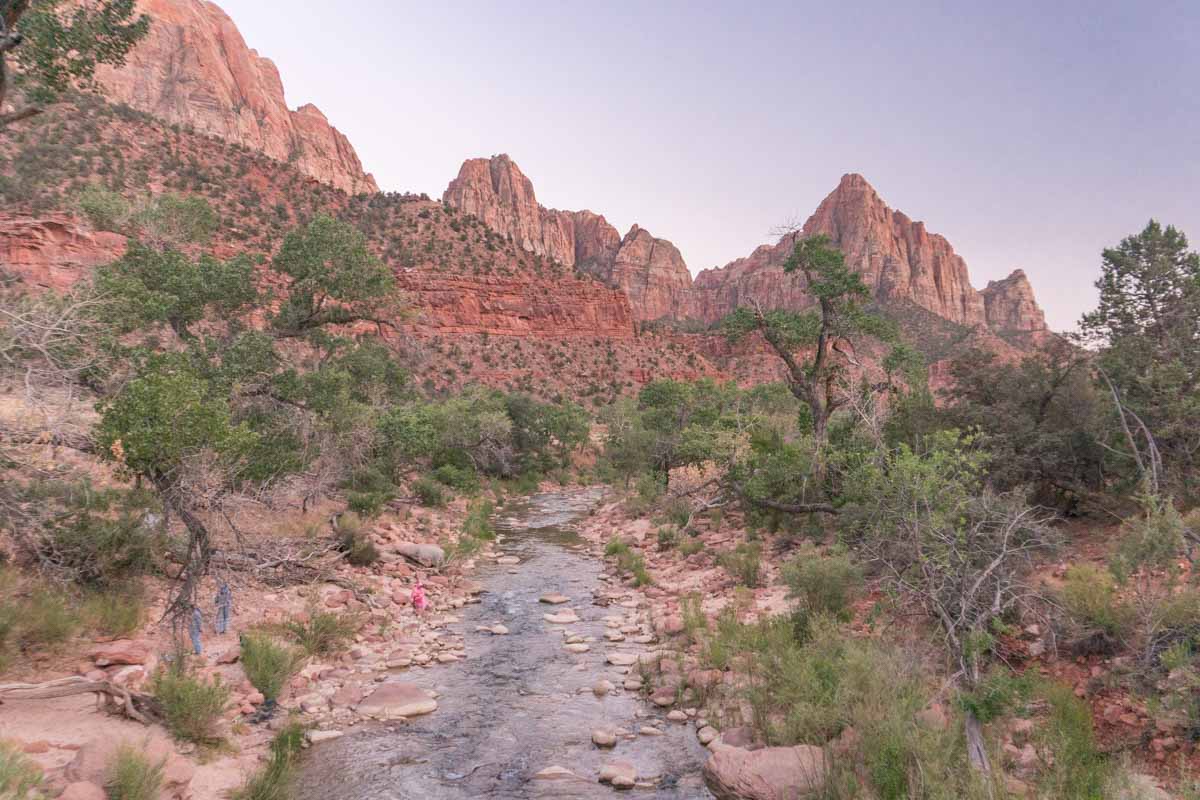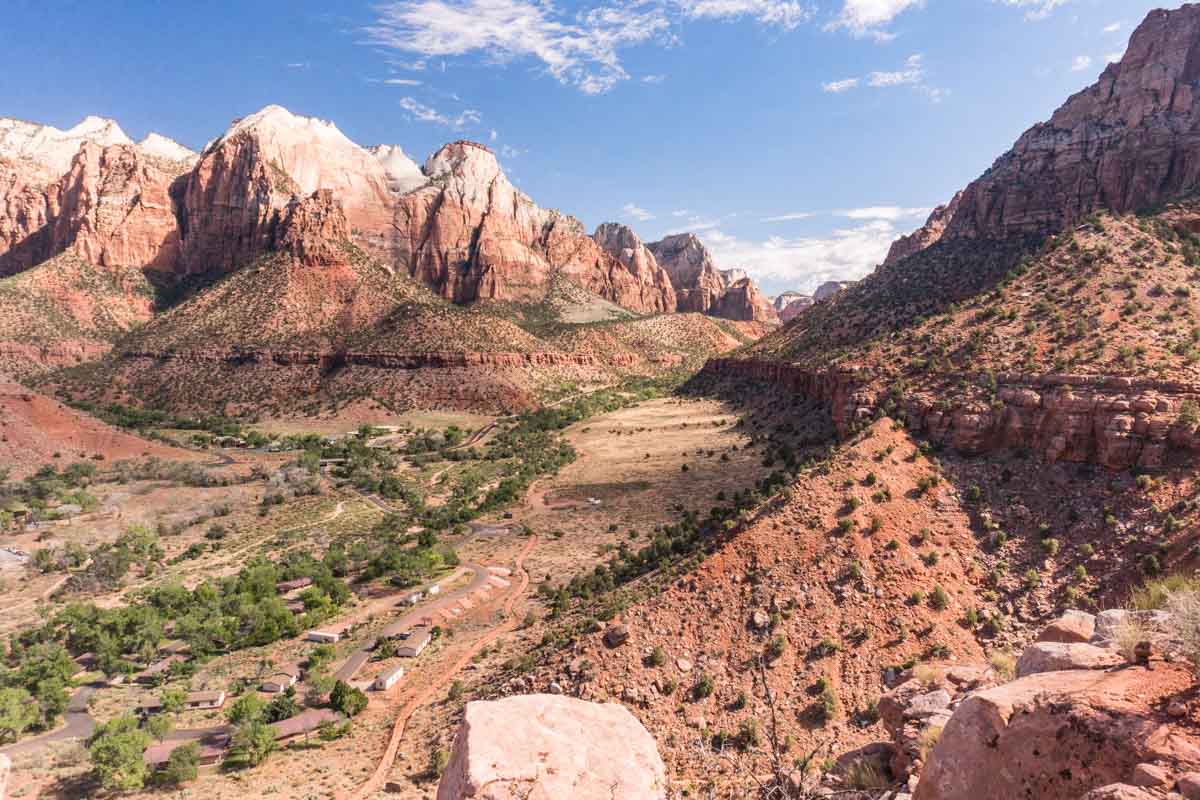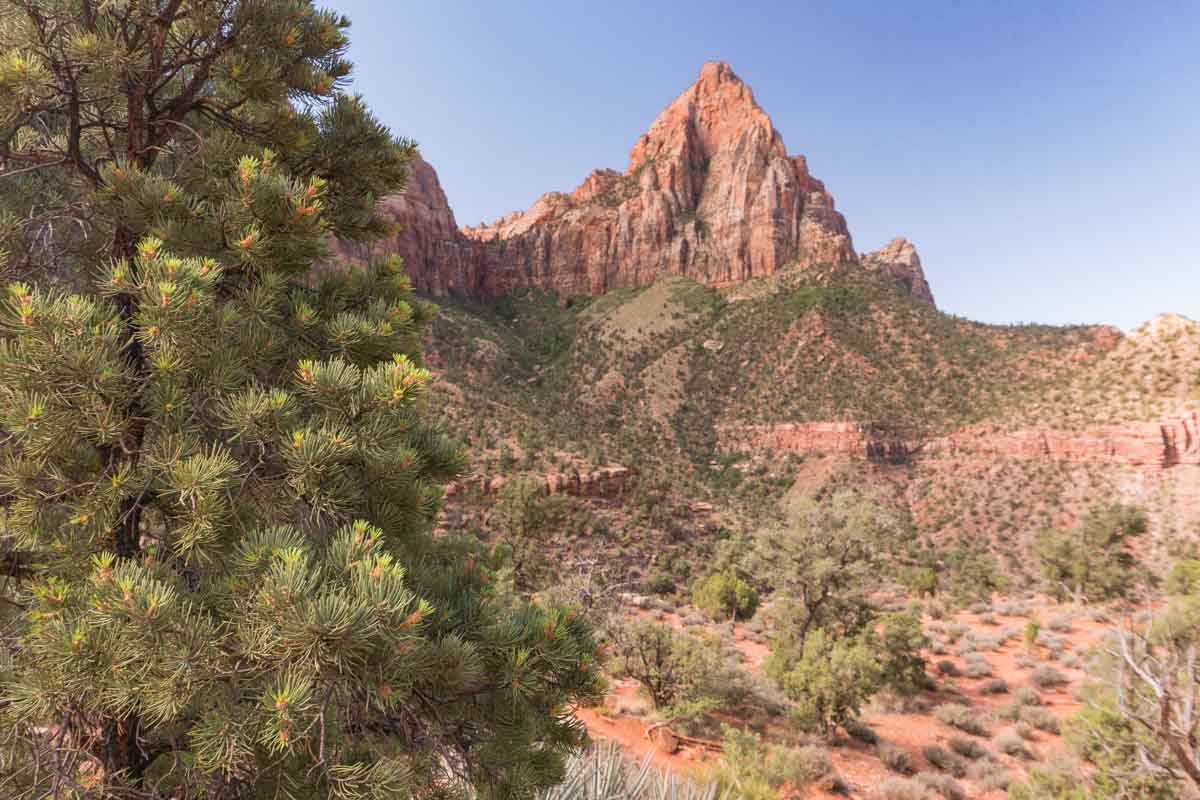
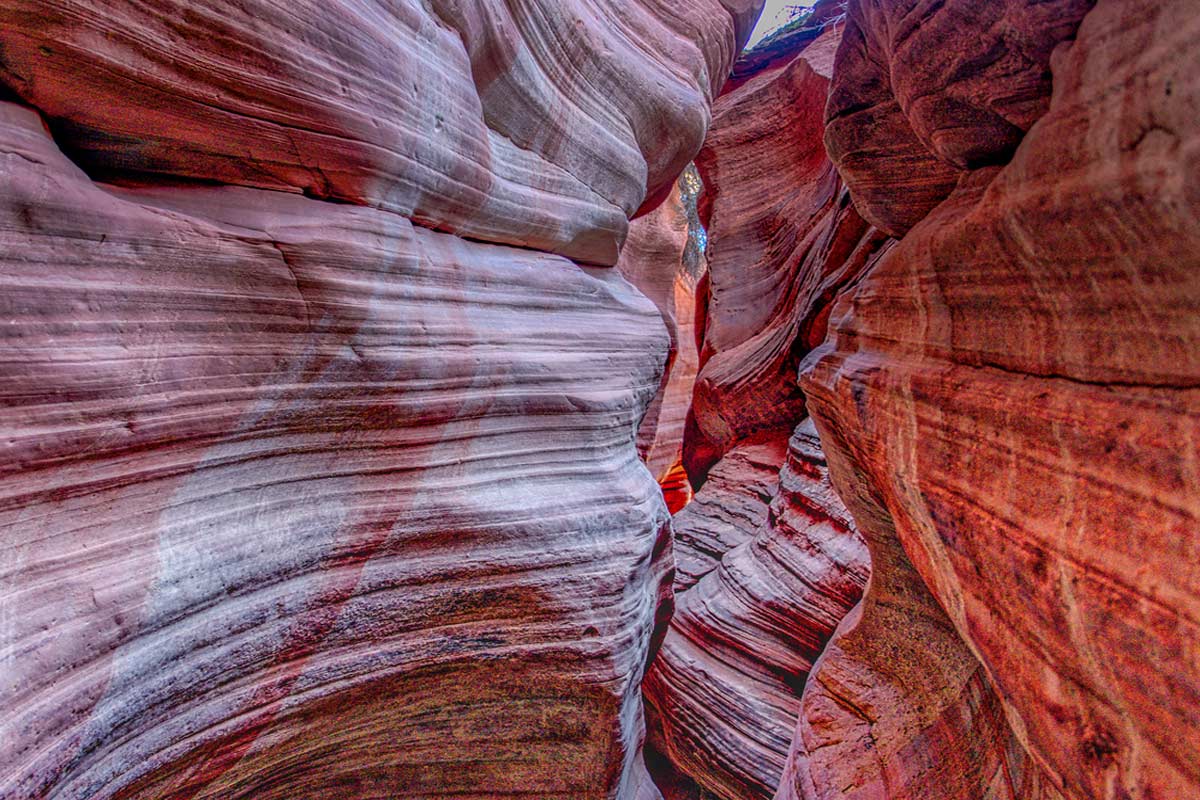
The Red Caves are a pair of slot canyons cut into the Elkheart Cliffs near Mount Carmel Junction, 15 to 20 minutes’ drive from Zion’s East Entrance. They sit outside the park, in Sand Wash in Kane County, and they’re one of the most photogenic short adventures on the east side of Zion: swirling red and cream Navajo Sandstone, walls narrow enough to touch both sides at once, and a few scrambles to keep things interesting.
The catch in 2026 is access. Every route into the canyons crosses private land, and the traditional trailheads are now signed or reported closed, so a guided tour is the reliable way to see them. This guide covers where the Red Caves are, what the upper and lower canyons are like, how to visit, and where to stay nearby.
Why Visit the Red Caves, Utah?
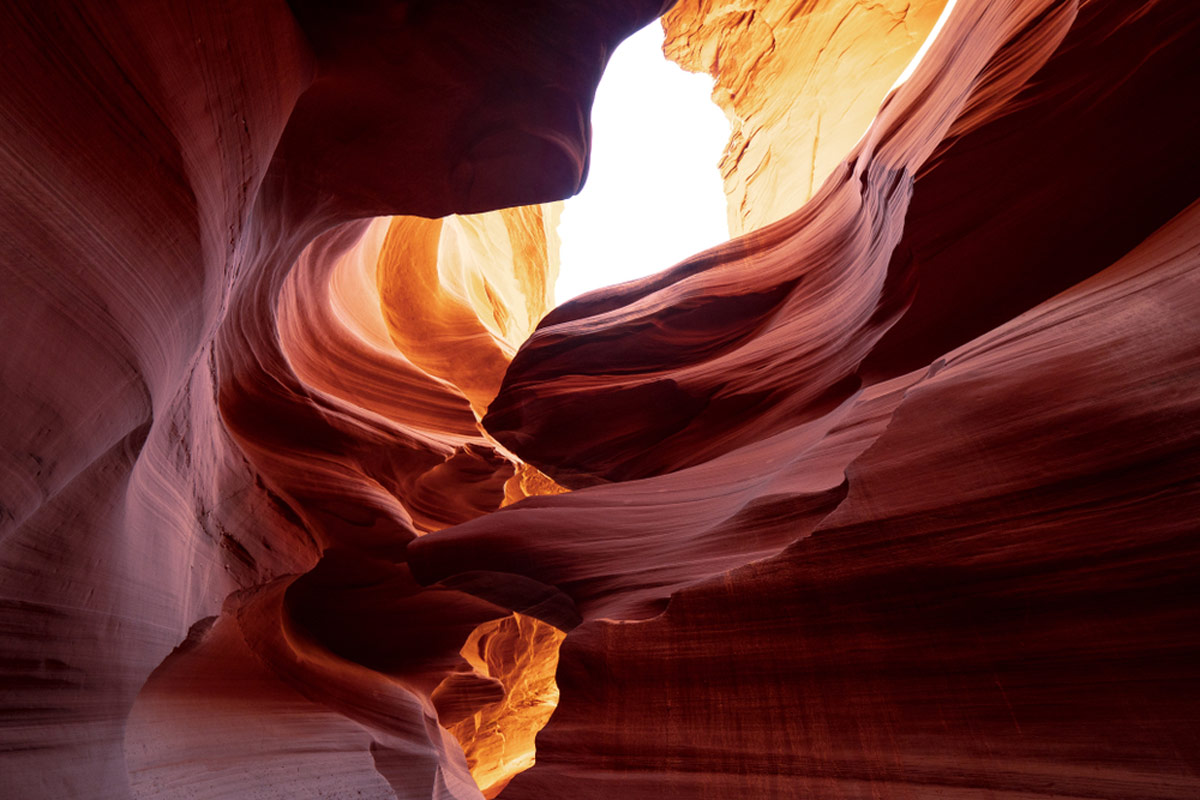
Zion’s famous slot canyon is The Narrows, a wade up the Virgin River that can see hundreds of hikers a day in summer. The Red Caves give you a smaller, drier and far quieter version of the same experience: red, cream and pink sandstone carved into smooth, curving walls, with light bouncing down from a slit of sky overhead.
They also fit neatly into a road trip through Utah. Mount Carmel Junction is on the main route between Zion and Bryce Canyon, so a morning in the Red Caves works well on the day you drive between the two. If you’re spending longer in Zion itself, combine them with Angels Landing or The Narrows for a few days of very different canyon country.
Where Are the Red Caves?
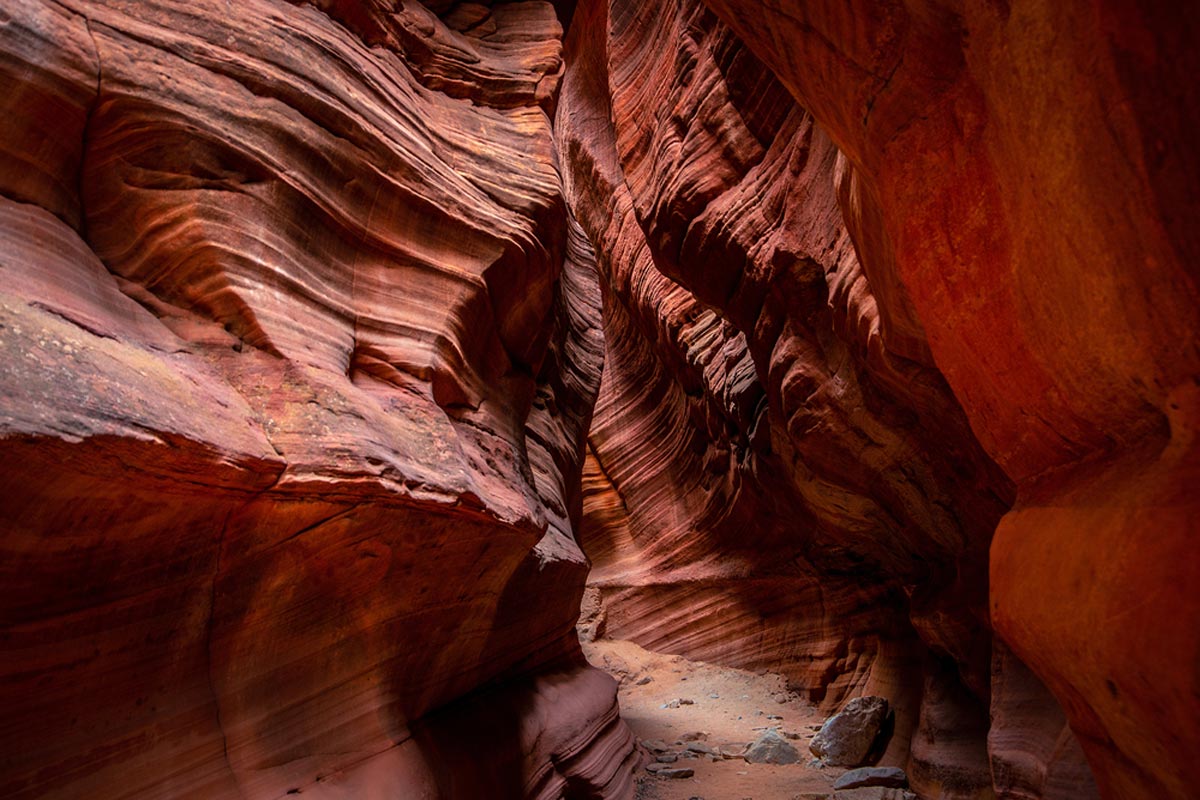
Despite the name you’ll often see online, the Red Caves aren’t in Zion National Park. They’re two forks of a slot canyon system in Sand Wash, below the Elkheart Cliffs on the east side of Long Valley, across the valley from the small towns of Mount Carmel and Mount Carmel Junction. You’ll also see them called Red Cave, Sand Wash or the Upper and Lower Red Caves.
Because they’re outside the park, you don’t need a National Park Service permit to visit. The canyons themselves are largely public land, but every approach crosses private property, which is why access has become complicated (more on that below).
How the Red Caves Formed
The caves are carved into Navajo Sandstone, the same rock that forms Zion’s great cliffs. It was laid down as a vast desert of windblown sand dunes in the Early Jurassic, around 180 to 185 million years ago, which is why you can see the sweeping diagonal lines of ancient dunes (cross-bedding) in the walls. Over millions of years, flash floods have scoured narrow channels through the rock and polished them smooth. The sandstone runs red lower down and paler higher up, and the colours shift through the day as the sun moves overhead.
Zion National Park, next door, has its own long history. It was first protected as Mukuntuweap National Monument on 31 July 1909, renamed Zion National Monument in 1918 and made a national park in November 1919, which makes it Utah’s first national park.
The Red Caves: Upper and Lower Canyons
Sand Wash splits into two forks, each with its own slot. If you’re hiking, the classic route goes up the Lower Red Cave, crosses country between the two forks and comes back down the Upper Red Cave. It’s around 7 miles (11km) in total, much of it on soft sand, and takes most of a day. Tours use utility vehicles (UTVs) to cut out most of the sand walking.
Upper Red Cave
Contrary to what you might expect, the Upper Red Cave is the easier of the two to explore from below. The slot is short, roughly a third of a mile, and walking up it is non-technical, though you’ll need to scramble up a few dry falls of up to about 10 feet (3m). Hiked alone from the old trailhead, it’s a round trip of around 4.4 miles (7km).
The narrowest sections are the most dramatic part of either canyon: smooth Navajo Sandstone curving overhead, often barely shoulder-width apart. Be ready for water. The Upper cave tends to hold the deepest potholes, and after rain some can be waist-deep or more, cold and muddy.
Coming down from the top is a different matter. There’s a drop of around 25 feet (8m) into the slot that canyoneers either rappel or downclimb, so it’s not for casual hikers.
Lower Red Cave
The Lower Red Cave is longer, at around 0.8 miles, and much trickier. Near its lower end there are two big drops, one beneath a wedged boulder (a chockstone), which route descriptions put at roughly 20 to 40 feet (6 to 12m) each. Canyoneers rappel them from bolted anchors, and guided canyoneering tours do the same.
Hikers without ropes can bypass the drops on a steep, sandy slope above the canyon, then climb back down into the slot. Above that comes about half a mile of narrows with several 4 to 7-foot (1 to 2m) climbs over chockstones and small pools. It’s only for confident scramblers, and you’ll feel it in your calves after all that sand.
You may find old ropes left at the drops by previous groups. Don’t trust them: they’re exposed to sun and floodwater, and nobody maintains them.
Planning Your Visit to the Red Caves
Getting to the Red Caves
The caves are near Mount Carmel Junction, where Highway 9 from Zion meets US-89, about 17 miles (27km) north of Kanab. Tours start from Mount Carmel and Orderville, a few miles north of the junction on US-89.
- From Springdale: about 27 miles, 50 to 55 minutes, via the Zion-Mount Carmel Highway through the park and its tunnel. Even driving through, you need a park pass: $35 per private vehicle, and from 1 January 2026 non-US residents aged 16 and over also pay a $100 fee per person at Zion. See the National Park Service fees page for the details.
- From Kanab: about 19 miles, around 25 minutes north on US-89, with no park fees.
- In an RV or towing: since 7 June 2026, vehicles over 35 feet 9 inches long, 7 feet 10 inches wide or 11 feet 4 inches high, or over 50,000 pounds, are banned from the whole Zion-Mount Carmel Highway, not just the tunnel. Combinations are limited to 50 feet overall. If you’re over the limits, drive round via Hurricane, Highway 59, Fredonia and Kanab. The park’s large vehicles page has the full rules.
Visiting the Red Caves Independently
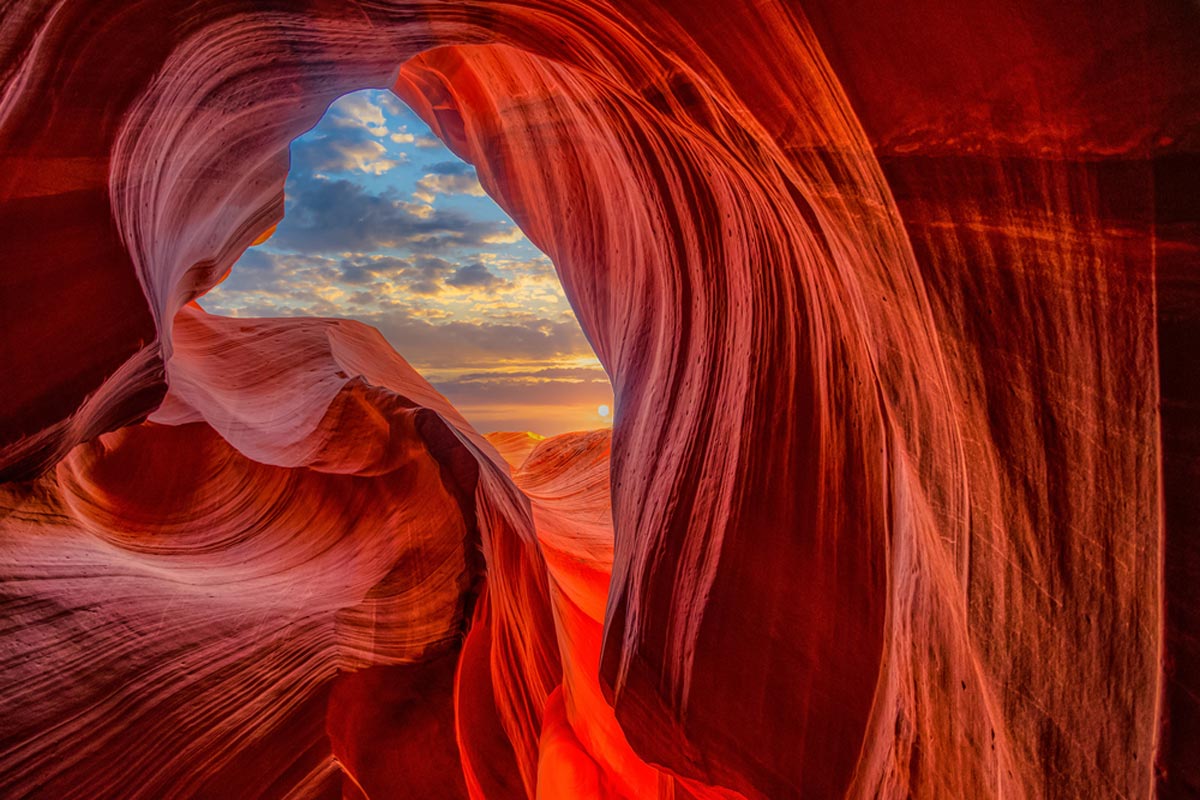
Visiting on your own used to be straightforward, but it isn’t any more. There were two traditional ways in, and both cross private land:
- From US-89 at the mouth of Sand Wash, just north of Mount Carmel Junction. This route is reported closed, with no-trespassing signs along the wash.
- From Tait Lane in Mount Carmel, about 2.5 miles north of the junction. Hikers used to ask the landowners for permission here, but recent reports say the land is gated and signed no trespassing.
We couldn’t find any official notice from the landowners, the Bureau of Land Management or Kane County confirming that either route is open to the public. Please don’t cross private land without permission. Until that changes, a guided tour is the way to go.
On a Tour
Local outfitters on the east side of Zion run trips into the slot canyons below the Elkheart Cliffs, usually combining a UTV ride across the sand with short hikes or canyoneering.
- ROAM Outdoor Adventure Co (also sold as East Zion Experiences) is the operator that names the Red Caves in its tours. Its two-hour East Zion slot canyons UTV tour visits both the Upper and Lower Red Cave, with only about a quarter of a mile on foot, and costs from around $149. Its six-hour Ultimate Slot Canyon Canyoneering UTV Adventure adds a rappel in the Lower Red Cave and nearby Ladder Canyon, from around $250 with harness, helmet and ropes included. Tours meet at ROAM’s storefront on Highway 89 in Orderville, next to East Zion Resort.
- East Zion Adventures, based at Zion Ponderosa Ranch Resort, runs slot canyon trips in the same area, including the non-technical Crimson Canyon Hike & UTV Adventure (from around $129, ages four and up) and the Elkheart Canyoneering & UTV Adventure, with rappels of up to 100 feet. Check with them which canyons each trip visits.
Prices change through the year, so check with the operator before you book. If you’re coming from Las Vegas without a car, multiday tours combine Zion with Bryce Canyon, the Grand Canyon and Monument Valley, but they stick to Zion’s main canyon and don’t visit the Red Caves.
When to Visit the Red Caves
Spring and autumn are the best seasons. Summer days are very hot out on the open sand, and July to September is monsoon season, when afternoon thunderstorms bring a real risk of flash floods. Storms 15 to 20 miles away can send water down a slot canyon under a clear sky, so check the forecast on the morning of your trip and never enter a slot if storms are forecast. Floods also move sand and boulders around, so the obstacles can change from one visit to the next.
Where to Stay near the Red Caves
For the Red Caves, the most convenient bases are on the east side of Zion around Mount Carmel Junction and Orderville. If you’d rather stay in Springdale for the main canyon, the caves are an easy morning trip through the park.
Best Western East Zion Thunderbird Lodge
Right on the junction of Highway 9 and US-89, Best Western East Zion Thunderbird Lodge is a classic roadside lodge a few minutes’ drive from the tour start points. Rooms look out over the mountains or the pool, and there’s a hot tub, a nine-hole golf course and the Thunderbird Restaurant, long known for its pies.
Check Rates and Availability at the Thunderbird Lodge
Arrowhead Country Cabins
About 2.5 miles north of the junction in Mount Carmel, Arrowhead Country Cabins (formerly Arrowhead Country Inn) is the closest place to stay to the Red Caves. It has country-style cabins with a farm breakfast, a pool and a hot tub, and it’s around 18 minutes to the park’s East Entrance.
East Zion Resort
For glamping, East Zion Resort in Orderville has yurts, glamping tents with air conditioning and private bathrooms, treehouses and Airstream trailers, plus pools. It’s next door to ROAM’s meeting point, around 10 minutes north of Mount Carmel Junction.
89 & Nine Motel
A simpler option beside the golf course at the junction, 89 & Nine Motel has rooms with private entrances, a fridge, microwave and coffee machine, and free parking. Check-in is through a virtual front desk.
Check Rates and Availability at 89 & Nine Motel
Zion Mountain Ranch
Just outside the East Entrance on Highway 9, Zion Mountain Ranch has private cabins and lodges on a ranch with its own bison herd, plus a farm-to-table restaurant. It’s a good choice if you want to split your time between the Red Caves and the park.
Check Rates and Availability at Zion Mountain Ranch
Red Cliffs Lodge Zion (formerly La Quinta), Springdale
The former La Quinta in Springdale reopened as Red Cliffs Lodge Zion, part of Marriott’s Tribute Portfolio, in late 2024. It has 132 rooms on Zion Park Boulevard and its own restaurant, Scout Bar & Grill, and it’s a comfortable base for the main canyon if you’re doing the Red Caves as a day trip.
Check Rates and Availability at Red Cliffs Lodge Zion
Hyatt Place Springdale (formerly Holiday Inn Express)
The former Holiday Inn Express in Springdale became Hyatt Place Springdale/Zion National Park in 2025. It’s about 1.6 miles from the park entrance at shuttle Stop 6, with a seasonal heated pool, two hot tubs and free breakfast.
Check Rates and Availability at Hyatt Place Springdale
Cable Mountain Lodge, Springdale
For the best Zion Canyon views, Cable Mountain Lodge is about as close to the park as you can stay without being in it: a four-minute walk from the pedestrian entrance, with the Zion Canyon Village shuttle stop across a footbridge. All its suites and studios have kitchens or kitchenettes, and there’s a pool and hot tub looking up at the canyon walls.
Check Rates and Availability at Cable Mountain Lodge
For more options, see our full guide to where to stay in and near Zion National Park.
What to Pack for the Red Caves
- A good sunscreen is crucial. Utah’s sun is harsh, and the walk across the open sand to the caves has no shade.
- A refillable water bottle is essential, and carry more water than you think you’ll need. Soft sand and scrambling are hard work in the heat.
- Bring snacks or trail mix to keep you going, especially if you’re on a longer canyoneering trip, where you’ll usually need to bring your own lunch.
- Pools in the slots can be cold and deep after rain, so pack a lightweight jacket and quick-dry hiking trousers.
- Wear a good pair of hiking shoes with plenty of grip that you don’t mind getting wet. Wet sandstone is slippery, especially after wading through pools.
- Hiking poles help on the long sandy stretches, though you’ll want to stow them for the scrambles inside the slots.